allium
Solutions Engineer
On-siteFull-timePosted Unknownvia ashby
Job Description
The 4 biggest blockchain strengths are also its weakness
Permissionless nature leads to fragmentation of meaning
Decentralization leads to too many standards
Immutability leads to exponential data + query infrastructure complexity
Neutrality means that no one is accountable for interpretations
Blockchain data is public. It is not usable at institutional scale. Despite being open, blockchain data is fragmented, hard to interpret, and painful to maintain. Even a simple question like “Who are the largest Ethereum token holders over time?” can require running nodes, ingesting full chain history, decoding contracts, cleaning edge cases, and writing complex SQL.
Blockchains are optimized for writes, not reads.
They are built for consensus and execution, not searchability, standardization, or financial interpretation. Blockchains are computers, not databases. Every protocol defines its own schema. The same economic action can be encoded in dozens of different ways. The result:
Fragmented standards
Exponential complexity
No accountability for interpretation
Events without economic meaning
Finance cannot operate on that, it needs an effective system of record.
Allium is building the System of Record for Onchain Finance
Allium ingests, verifies, and standardizes data across 140+ blockchains and 30+ petabytes of history. We close four structural gaps that prevent blockchains from becoming systems of record:
Semantic Gap: Translating raw events into financial concepts like payments, trades, deposits, and staking income
Standardization Gap: Mapping thousands of protocols into a single canonical cross chain schema
Infrastructure Gap: Read optimized, globally distributed data at web scale
Accountability Gap: Auditable methodology, SLAs, and SOC 1 and 2 compliance
The result is a neutral, canonical data layer institutions can build on with confidence.
Finance is moving onchain
Stablecoins, tokenized assets, trading, staking, and lending are growing rapidly. Institutions need a trusted source of truth for onchain financial activity, just as they rely on Bloomberg or DTCC in traditional markets. Raw blockchains cannot serve that role.
As AI agents begin transacting autonomously, the requirement becomes even stricter. Agents cannot reason over raw event logs. They need structured data, attribution, condition checks, and auditability.
Allium is the read layer that makes onchain finance usable for humans and machines.
Who We Serve
Allium powers three core personas with the same canonical data foundation:
1. Finance, Accounting, and Risk TeamsThey need reliable, audit grade answers. They rely on Allium for financial reporting, reconciliation, compliance, risk monitoring, and defensible metrics that can stand up to auditors and regulators.
2. Engineers and Product Teams They need low latency, production ready infrastructure. They use Allium to power wallets, trading systems, payment rails, staking infrastructure, and real time applications that cannot break.
3. Strategy, Research, and Executive Teams They need clarity and insight. They use Allium to understand ecosystem economics, market structure, user behavior, competitive dynamics, and where capital is flowing onchain.
and of course.. agents 🦞. Our customers and users include Visa, Stripe, G-SIB Banks, Big 4 Accounting firms, BCG, Coinbase, Phantom, Uniswap and cited by the Federal Reserve.
Role Overview
The Solutions Engineer at Allium.so works closely with customers to ensure they get the most value from the entire Allium platform. This role is technical, customer-facing, and involves designing custom solutions to meet specific blockchain data needs.
Responsibilities
Engage with customers to understand their blockchain data requirements and provide expert guidance on using Allium.so's platform.
Design and implement tailored data analytics solutions, such as dashboards for transaction trends or custom reports for blockchain metrics.
Offer ongoing technical support, troubleshooting issues to ensure smooth platform usage.
Gather customer feedback to inform product improvements and work with product and engineering teams to prioritize new features.
Create and maintain documentation for customer implementations to support future operations.
Requirements
2-5 years experience in a similar role.
A Bachelor's degree in Computer Science, Data Science, Engineering, or a related field, with a Master's degree preferred.
Strong proficiency in programming languages like Python, SQL, and JavaScript, and experience with data analytics tools.
2-5 years of experience in data engineering, data analytics, or similar, with a track record of designing customer solutions.
Excellent communication and interpersonal skills, problem-solving abilities, and project management skills to handle multiple customer projects.
A solid understanding of blockchain technology and its data structures, with knowledge of data security and privacy best practices as a plus.
Don't take our word for it, what our customers say about us (https://www.allium.so/blog#love)
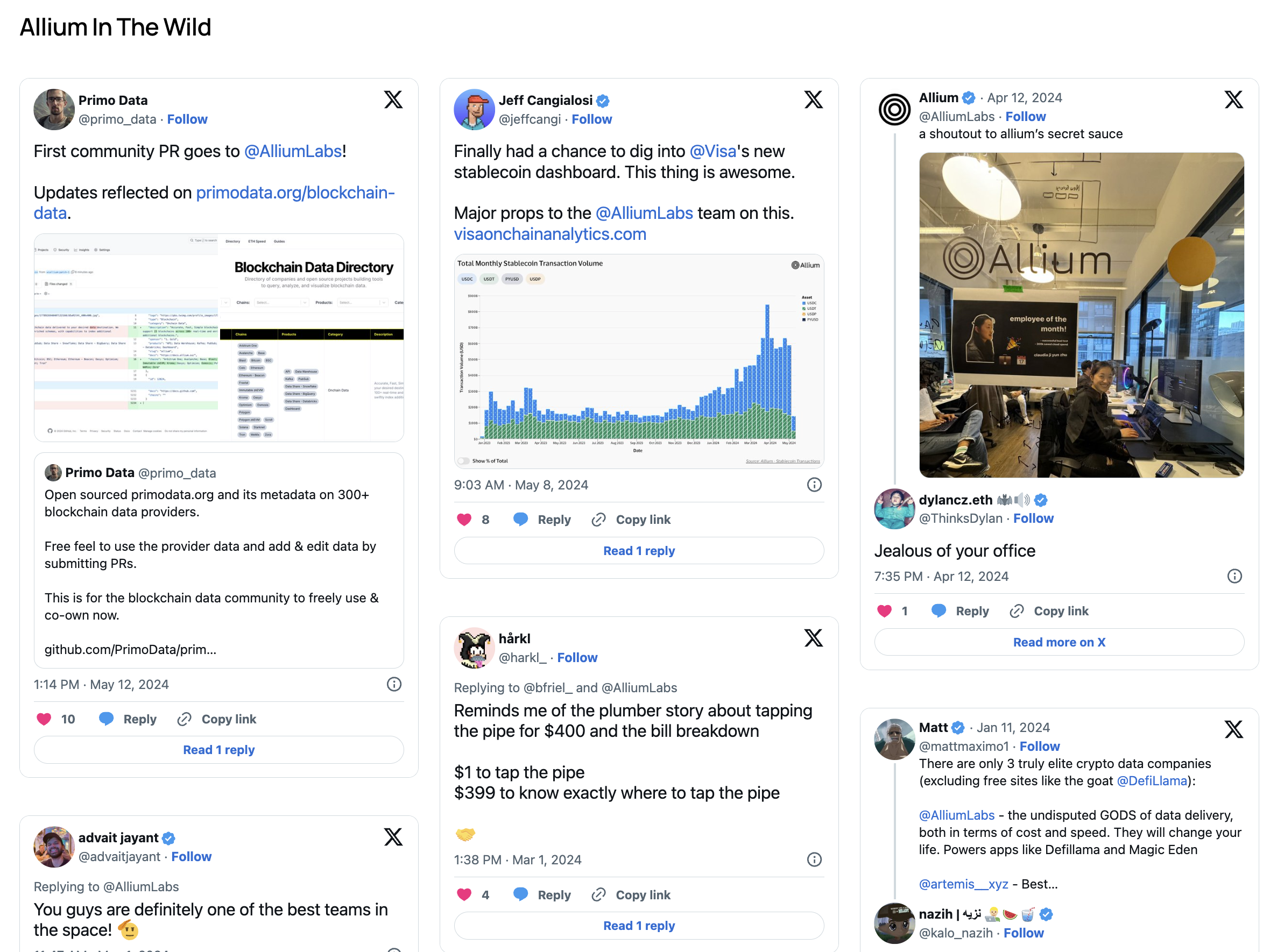
What some ~cool people have to say about us:
The Information's Top 50 Startups (https://www.allium.so/post/allium-named-to-the-informations-50-most-promising-startups-of-2025)
Mario Gabriele from The Generalist's Future 50 Startup List: https://www.allium.so/post/allium-named-awardee-of-the-generalists-inaugural-future-50-startups
Tomasz Tungus from Theory Ventures: https://tomtunguz.com/allium/
Bucky Moore from Kleiner Perkins: https://www.kleinerperkins.com/perspectives/allium-series-a/
Ok.. now for some tough love, here are the values we strive for at Allium:
Pro Athlete Mindset - Consistency. Day in and day out, in pursuit of excellence. A win yesterday does not guarantee (or even imply!) a win tomorrow. I hope anyone who supports a failing sports team will feel the pain (cough Man United fans) of inconsistency
Figure It Out & Extreme Ownership - Eve
About allium
allium